
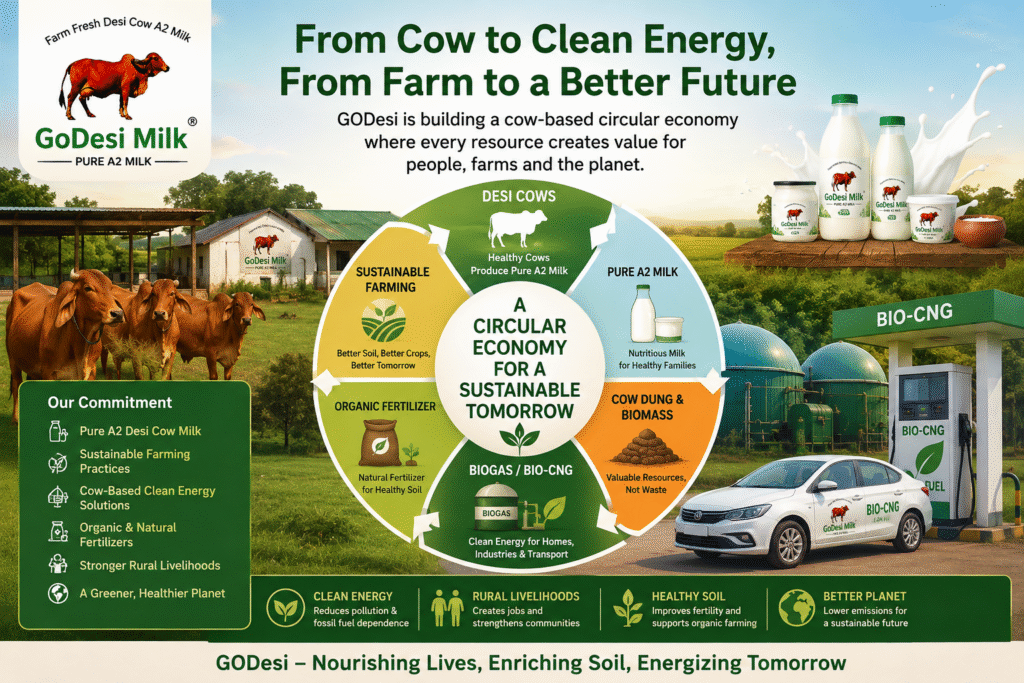
India’s dairy sector is entering a new era. For decades, the conversation around Gir cows has focused primarily on milk production, but today the discussion is expanding to include clean energy, organic fertilizers, rural livelihoods, and sustainable farming. As India accelerates its renewable energy ambitions, Bio-CNG (Compressed Biogas) is emerging as one of the most promising opportunities for dairy farmers and agricultural communities.
At GODesi, this is not a new idea. Long before Bio-CNG became a national talking point, we had already begun working toward a Gir cow-based circular economy where every resource generated by our farms—from milk to Gir cow dung and agricultural biomass—can contribute to a larger ecosystem of sustainability and value creation.
A New National Focus on Bio-CNG
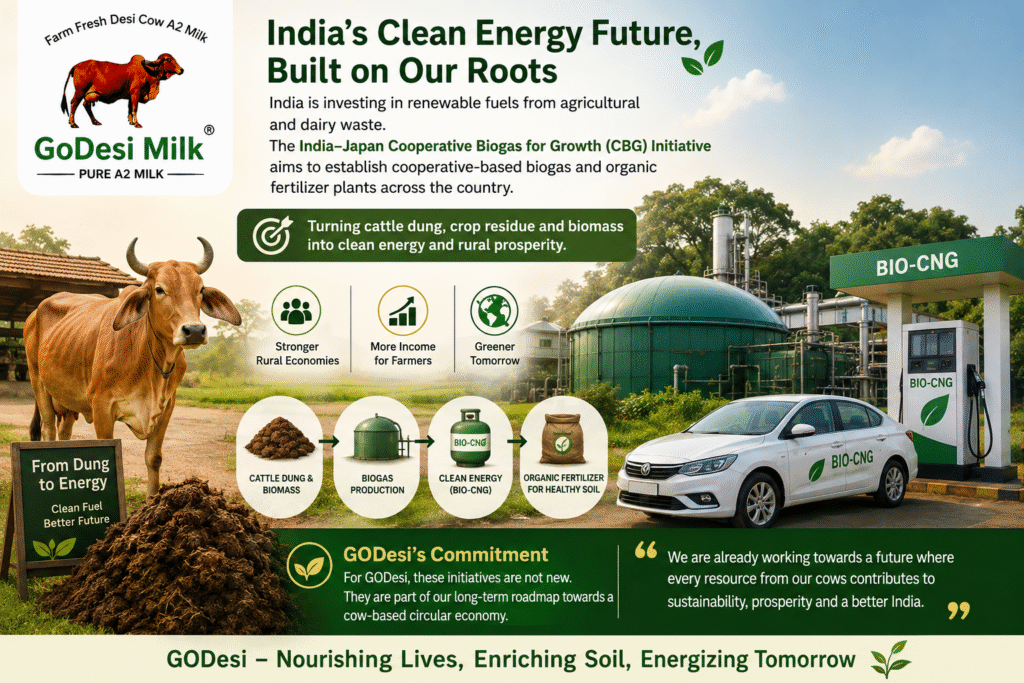
India is increasingly investing in renewable fuels produced from agricultural and dairy waste. Recent policy initiatives and international collaborations, including the India–Japan Cooperative Biogas for Growth (CBG) Initiative, have highlighted the potential of establishing cooperative-based biogas and organic fertilizer plants across the country. The goal is to convert cattle dung, crop residue, and biomass into clean energy, while creating additional income opportunities for farmers and strengthening rural economies.
For GODesi, these developments reinforce a vision that has already been part of our long-term roadmap.
GODesi’s Circular Dairy Vision
GODesi was founded with a simple mission: to deliver pure A2 Gir cow milk while building a farming model that is environmentally responsible and economically sustainable. Over time, we realized that the true potential of a dairy farm extends far beyond milk production.
Our ongoing work includes:
- Sustainable management of Gir cow dung and agricultural biomass
- Development of organic manure and soil-enhancing products
- Exploration of Bio-CNG / Compressed Biogas (CBG) solutions
- Integration of dairy farming with organic agriculture and renewable energy
- Creation of a farm ecosystem where waste becomes a valuable resource
This integrated approach allows us to reduce waste, improve farm efficiency, and create additional value for farmers and rural communities.
Why Bio-CNG Matters for India
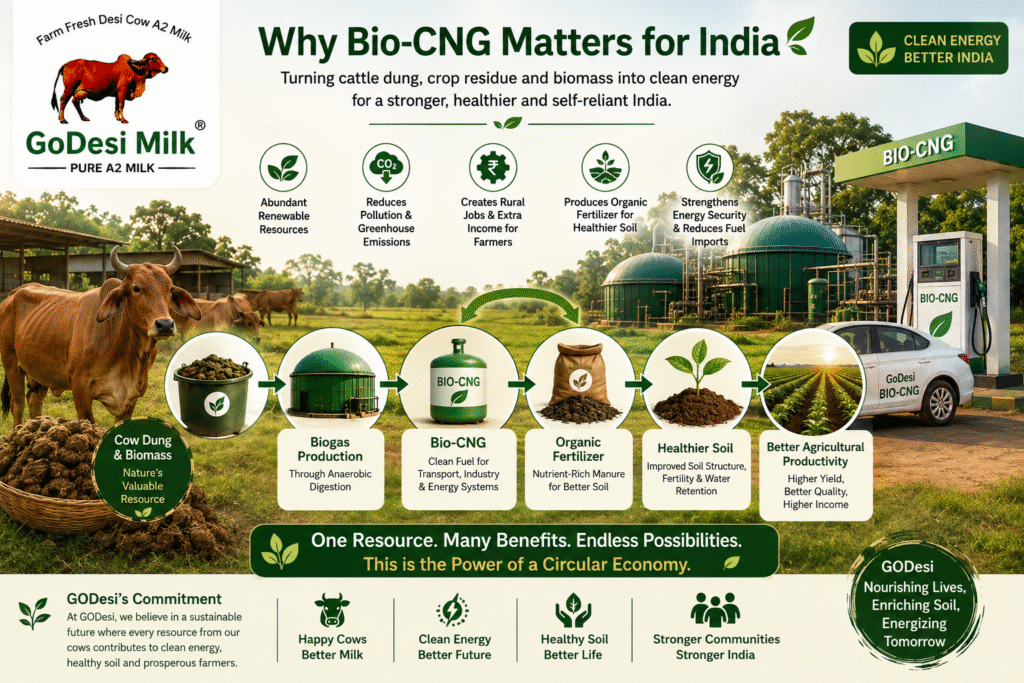
Every day, millions of cattle across India generate enormous quantities of dung. Combined with crop residue and other agricultural biomass, this creates one of the world’s largest renewable feedstock resources. Instead of allowing these materials to decompose or be burned in the open, they can be converted into Bio-CNG, a clean fuel that can be used in transportation, industries, commercial establishments, and energy systems.
A Bio-CNG plant produces not only renewable fuel but also organic fertilizers that can improve soil health and reduce dependence on chemical inputs. This creates a powerful cycle:
Gir Cow Dung & Biomass → Biogas Production → Bio-CNG → Organic Fertilizer → Healthier Soil → Better Agricultural Productivity
This is the essence of a circular economy, where one farm output becomes the input for another valuable product.
From Dairy Farming to Energy Farming
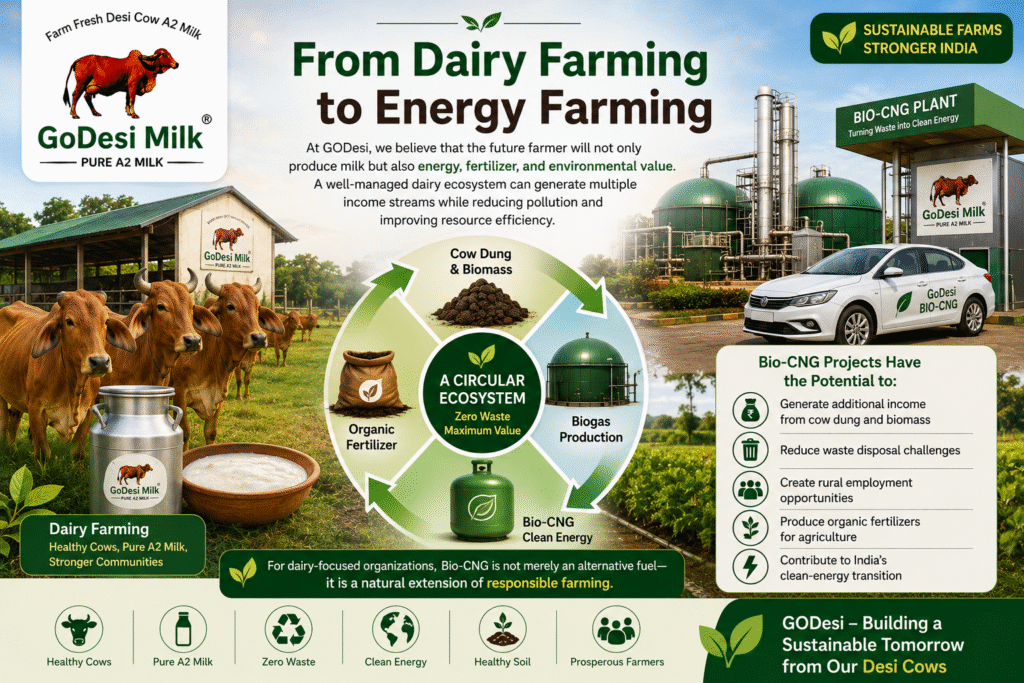
At GODesi, we believe that the future farmer will not only produce milk but also energy, fertilizer, and environmental value. A well-managed dairy ecosystem can generate multiple income streams while reducing pollution and improving resource efficiency.
Bio-CNG projects have the potential to:
- Generate additional income from Gir cow dung and biomass
- Reduce waste disposal challenges
- Create rural employment opportunities
- Produce organic fertilizers for agriculture
- Contribute to India’s clean-energy transition
For dairy-focused organizations, Bio-CNG is not merely an alternative fuel—it is a natural extension of responsible farming.
Strengthening Rural Communities
One of the most encouraging aspects of India’s Bio-CNG movement is its focus on cooperative and community-based development. Rural India already possesses strong dairy networks, farmer groups, and local agricultural ecosystems. When renewable energy is integrated with these existing structures, the benefits extend beyond individual farms.
Bio-CNG and organic fertilizer projects can support:
- Farmer cooperatives
- Dairy societies
- Village-level enterprises
- Biomass collection networks
- Rural entrepreneurship
- Local employment generation
GODesi believes that sustainable agriculture should create prosperity not only for the farm owner but also for the surrounding community.
Our Road Ahead
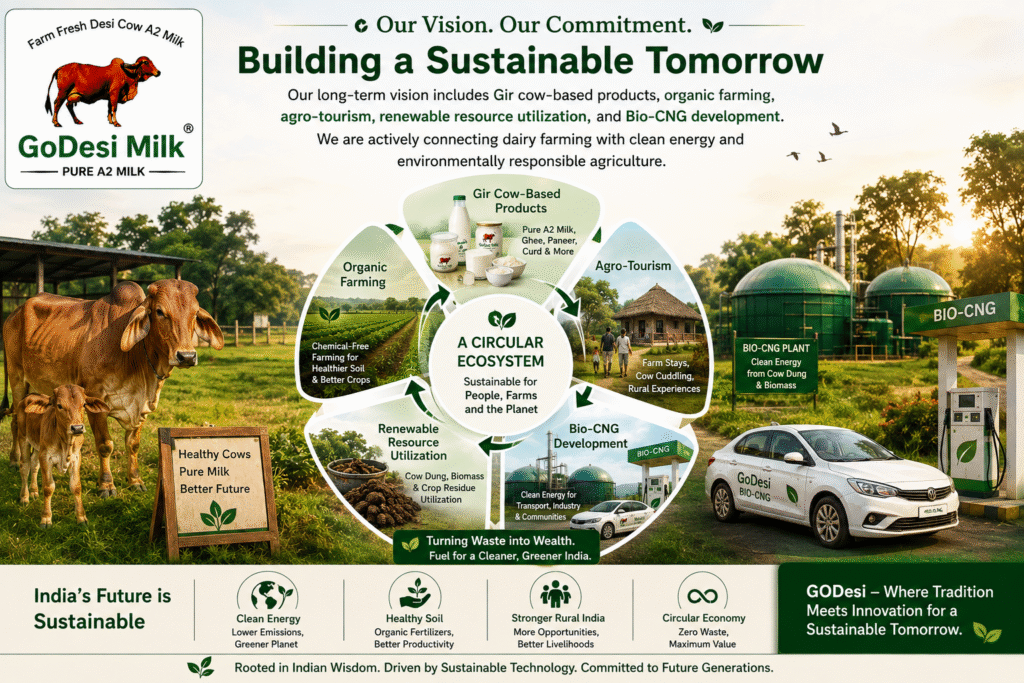
Our long-term vision has always included Gir cow-based products, organic farming, agro-tourism, renewable resource utilization, and Bio-CNG development. We are actively exploring opportunities that connect dairy farming with clean energy and environmentally responsible agriculture.
As India moves toward a future powered by renewable fuels, organic farming, and circular resource management, GODesi remains committed to building a model that combines traditional Indian dairy wisdom with modern sustainable technology.
Conclusion
The growing national focus on Bio-CNG confirms an important truth: Gir cow dung and agricultural biomass are not waste—they are valuable renewable resources. The transformation of dairy farms into integrated energy and agriculture ecosystems is no longer a distant possibility; it is becoming a practical direction for the future of rural India.
At GODesi, we are proud to be part of this journey. Our commitment extends beyond delivering high-quality A2 milk—we are working toward a future where Gir cows, healthy soil, clean energy, and rural prosperity grow together.
Reference
This article is an original blog prepared by GODesi using publicly available information on India’s compressed biogas (CBG) and Bio-CNG sector.
Reference source: PelletRates (Peltra Energy) – “India and Japan Launch CBG Initiative to Build 1000 Cooperative-Based Biogas Plants by 2030,” published on 20 July 2026. Available at: https://www.pelletrates.com/policies-and-schemes/news/india-japan-cbg-initiative-1000-biogas-plants-cooperative
Additional context has been derived from publicly available government announcements and reports on India’s renewable energy and Bio-CNG initiatives.